
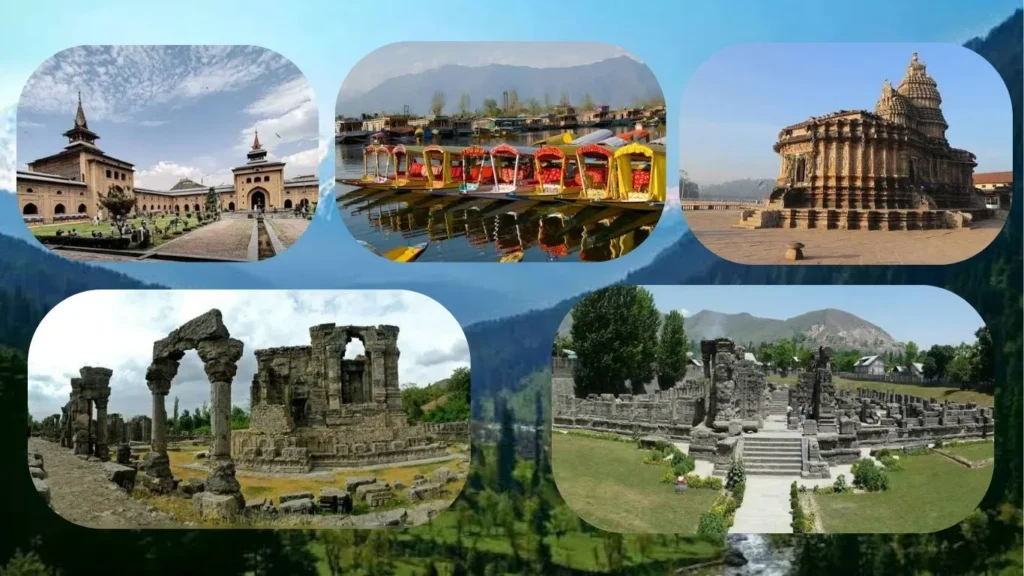
When people think of Kashmir, they picture snow-capped peaks, houseboats on the Dal Lake, and endless meadows. But very few travellers know that beneath this beauty lies one of the oldest and most layered histories in the Indian subcontinent: a story of ancient lakes, lost civilisations, and forgotten kingdoms that most tour itineraries never even mention.
A Land Older Than You Think
Long before Kashmir became a valley, it was a massive lake. Around 85,000 years ago, shifting tectonic plates slowly drained this lake, exposing a fertile stretch of land known as the Karewas. This land eventually became home to some of the earliest human settlements in India. Evidence of habitation here goes back nearly 5,000 years.
Burzahom: Kashmir’s Oldest Secret
One of the most remarkable discoveries in this region is Burzahom, a Neolithic site where archaeologists found underground pit-dwellings, proof that people were living here thousands of years before recorded history. Kashmir has 14 known Neolithic sites, but Burzahom remains the most significant. Interestingly, this ancient excavation site now doubles up as the venue for a popular local cricket tournament, a strange but telling example of how disconnected present-day Kashmir is from its own past. If you are planning a first visit, start with our guide to the 10 best places to visit in Kashmir.
Why Kashmir’s Heritage Got Left Behind
Experts believe decades of unrest are the biggest reason Kashmir’s archaeology never got the attention it deserved. During the 1990s insurgency, several central departments, including the regional office of the Archaeological Survey of India, relocated out of the valley and never fully returned. As a result, research slowed drastically. In fact, the University of Kashmir only opened a dedicated archaeology department in 2017, decades after most other Indian states already had one.
This gap shows in how heritage sites are treated today. Gufkral, an important prehistoric site like Burzahom, was never given official “protected” status despite being fully excavated, and parts of it have since been encroached upon.
The Gardens Everyone Knows, But No One Protects
Ironically, Kashmir’s most Instagrammed spots are also among its most under-protected. The Mughal Gardens, Nishat Bagh and Shalimar Bagh, aren’t classified as national monuments in Kashmir the way similar gardens are elsewhere in India. They currently fall under the Department of Floriculture, not the ASI. Heritage groups have spent over a decade lobbying to get them onto UNESCO’s World Heritage list, and they’re now on the tentative list, a small win after years of effort.
Kashmir’s Forgotten Buddhist Past
Here’s something almost no traveller expects: Kashmir was once a major hub of early Buddhism. It served as a key corridor through which Buddhism travelled along the Silk Route to the rest of Asia. The Harwan Monastery, on the outskirts of Srinagar, is believed to be where the Fourth Buddhist Council was held under the Kushana emperor Kanishka around the 1st to 2nd century CE. Today, this history-rich site sits quiet and largely unvisited, with no museum, no signage, and barely any visitors.
This blended past is visible in Kashmir’s architecture too. Many mosques in the valley feature shikhara-style roofs instead of domes, a direct visual mix of Hindu, Buddhist, and Islamic design traditions layered over centuries.
Parihaspora: The Capital Time Forgot
Founded in the 8th century CE, Parihaspora was once an ancient capital of Kashmir. Even though it holds protected status under the ASI, mining and construction activity around the site continue to threaten what remains of it.
Why This Matters for Travellers
Most Kashmir trips focus purely on scenery, but understanding this deeper history completely changes how you experience the valley. Standing at Harwan Monastery or walking through Nishat Bagh means a lot more once you know the layers of civilisation beneath your feet.
At AVS Global Tours, we go beyond the standard sightseeing checklist. Our Kashmir itineraries are designed to connect you with the region’s real heritage: ancient sites, living history, and stories most visitors never get to hear.
Planning your Kashmir trip? Talk to our travel team and explore the Kashmir most tourists never see.
Pingback: The Untold Stories of Kashmir — Living Traditions, Crafts, Festivals, and Flavours - AVSGlobalTours
Pingback: Wildlife Tourism in Jammu & Kashmir
Pingback: Kashmir Summer Adventure Activities 2026 | AVS Global Tours